Best Open-Source LLMs for Developers in 2026
Published on • Updated on
Large Language Models (LLMs) have become one of the most important technologies in modern software development. Developers are using LLMs to build AI applications, automate workflows, create intelligent assistants, improve search systems, and enhance developer productivity.
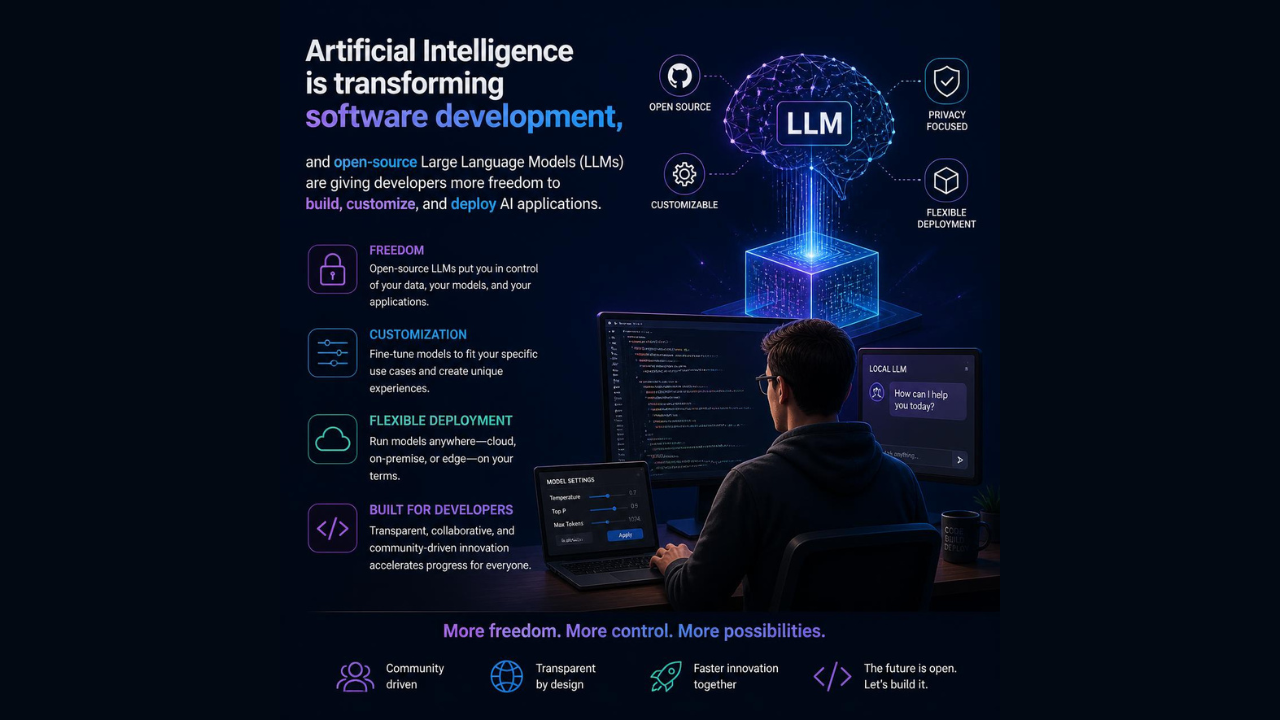
While many popular AI models are available through commercial APIs, open-source LLMs give developers more control, flexibility, customization options, and privacy.
In 2026, open-source AI models are becoming more powerful, making it easier for developers to build, fine-tune, and deploy their own AI solutions.
What Are Open-Source LLMs?
A Large Language Model (LLM) is an AI model trained on massive amounts of text data to understand and generate human-like language.
Open-source LLMs allow developers to:
- Run models locally
- Customize models for specific tasks
- Fine-tune models with their own data
- Build private AI applications
- Reduce dependency on external APIs
These models are widely used for:
- AI chatbots
- Code assistants
- Content generation
- Document analysis
- Search systems
- Automation tools
1. Llama — Meta's Open AI Model Family
Meta Llama
Llama is one of the most popular open-source LLM families created for developers and researchers.
Key Features:- Strong general-purpose performance
- Multiple model sizes
- Supports local deployment
- Large developer community
- AI applications
- Research projects
- Custom assistants
- Enterprise solutions
2. Mistral AI Models
Mistral AI
Mistral provides efficient and powerful open models designed for speed and performance.
Key Features:- Lightweight architecture
- Fast inference
- Strong reasoning capabilities
- Developer-friendly deployment
- Production AI applications
- Edge AI solutions
- Fast AI assistants
3. DeepSeek Models
DeepSeek AI
DeepSeek models have gained popularity among developers because of their strong coding and reasoning capabilities.
Key Features:- Code-focused models
- Efficient performance
- Strong mathematical reasoning
- Open model availability
- Programming assistants
- Software development tools
- AI coding applications
4. Qwen — Alibaba's AI Model Family
Qwen AI
Qwen models provide multilingual capabilities and strong performance across different AI tasks.
Key Features:- Multiple model sizes
- Multilingual support
- Coding capabilities
- Long context support
- Global applications
- Chatbots
- Enterprise AI systems
5. Gemma — Google's Open Models
Google DeepMind Gemma
Gemma is Google's family of lightweight open models designed for developers and researchers.
Key Features:- Efficient architecture
- Developer-friendly licensing
- Good performance on smaller hardware
- Learning AI development
- Mobile applications
- Research projects
6. Falcon LLM
Falcon LLM
Falcon is an open-source language model designed for high-quality text generation.
Key Features:- Open model access
- Strong language understanding
- Research-friendly
- NLP projects
- Text generation
- AI experiments
7. BLOOM
BigScience BLOOM Model
BLOOM is a multilingual open-source LLM created by the BigScience research community.
Key Features:- Supports many languages
- Open research model
- Community-driven development
- Multilingual AI applications
- Research
- Educational projects
How Developers Use Open-Source LLMs
Developers use open-source LLMs to build:
AI Coding AssistantsGenerate code, explain errors, and improve programming workflows.
AI ChatbotsCreate customer support bots and intelligent assistants.
Document Intelligence SystemsAnalyze documents, summarize information, and extract insights.
RAG ApplicationsCombine LLMs with private databases to create accurate AI search systems.
AI AgentsBuild systems that can perform tasks automatically.
Benefits of Open-Source LLMs
✅ Full control over AI models
✅ Better data privacy
✅ Custom fine-tuning options
✅ Lower long-term costs
✅ Local deployment possibilities
✅ Strong developer communities
Challenges of Open-Source LLMs
Despite their advantages, developers should consider:
Hardware RequirementsLarge models require powerful GPUs or cloud infrastructure.
Model ManagementDeploying and maintaining AI models requires technical knowledge.
Accuracy TestingDevelopers must evaluate models before using them in production.
SecurityAI applications need proper protection against misuse.
How to Choose the Right Open-Source LLM
Consider:
1. Use Case
- Coding
- Chatbots
- Research
- Automation
2. Model Size
- Smaller models for local devices
- Larger models for advanced tasks
3. Performance Requirements
- Speed vs accuracy
- Cost vs quality
4. Deployment Options
- Local servers
- Cloud platforms
- Edge devices
Updated on
